

Market analysis as of August 12, 2026
The cryptocurrency market is entering another important phase, with investors balancing macroeconomic uncertainty against improving blockchain adoption, institutional participation and continued development across major Layer-1 and Layer-2 ecosystems.
Recent market data puts total crypto market capitalization around $2.18–$2.2 trillion, while Bitcoin has been trading close to the $64,000 area. Ethereum has been around $1,870, while Solana has recently shown stronger short-term momentum than several other large-cap assets.
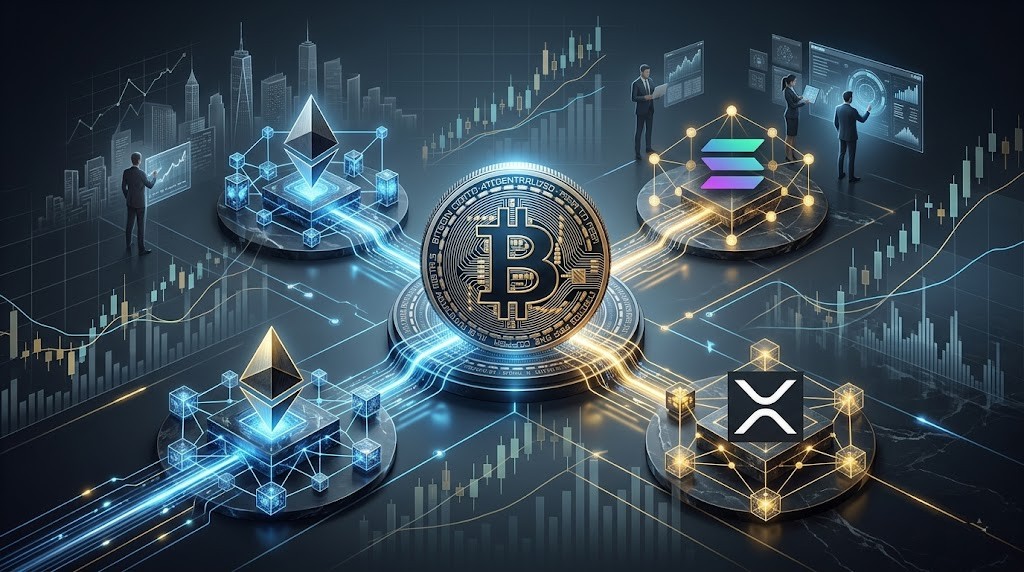
The current environment is particularly interesting because the market is no longer moving as one unified asset class. Bitcoin continues to behave like the market’s primary liquidity and institutional asset, while Ethereum, Solana, BNB Chain, XRP Ledger and other networks are competing through different approaches to scalability, payments, decentralized finance and real-world applications.
Bitcoin Remains the Market’s Primary Directional Indicator
Bitcoin continues to play the most important role in determining the broader direction of the cryptocurrency market.
After trading around the mid-$60,000 range, BTC has recently experienced some selling pressure as traders positioned cautiously ahead of new U.S. inflation data. Bitcoin slipped below $64,000 on August 11, highlighting how sensitive digital assets remain to macroeconomic developments.
For investors, the key issue is not simply whether Bitcoin moves higher or lower on a single day. Instead, market participants are watching whether BTC can establish a sustainable trend above important resistance zones while maintaining healthy trading volume.
Bitcoin’s institutional profile has also changed the structure of the market. Research from the IMF noted significant capital-flow changes in Bitcoin and Ether investment products during 2026, while broader market research has highlighted the growing importance of institutional participation.
This means Bitcoin increasingly acts as the market’s liquidity anchor. When BTC remains stable, capital can gradually rotate toward higher-beta assets. When Bitcoin experiences a sharp correction, however, altcoins typically face greater volatility.
Ethereum: Fundamental Activity Remains Important
Ethereum continues to occupy a unique position because it is not simply a cryptocurrency network. It remains a major settlement layer for decentralized finance, stablecoins, tokenized assets and a growing collection of Layer-2 networks.
Recent research and market reports indicate that Ethereum’s underlying ecosystem activity remains significant. One 2026 market report highlighted strong growth in Ethereum users, transaction activity and stablecoin supply, while Coinbase Institutional’s Q2 research specifically tracks Ethereum, stablecoins and Layer-2 activity as major indicators for understanding the market.
The important question for Ethereum investors is therefore whether network adoption will translate into stronger demand for ETH itself.
Ethereum’s position is also being challenged by faster and cheaper alternative networks. However, its large developer ecosystem, DeFi infrastructure, liquidity and role in stablecoin settlement continue to provide a strong foundation.
For long-term market participants, ETH should arguably be evaluated through two separate lenses: price performance and network utility. Short-term price action can be weak even when underlying blockchain activity remains healthy.
Solana Is Showing Stronger Short-Term Momentum
Solana has emerged as one of the most closely watched alternative Layer-1 networks in the current market.
Recent market coverage showed SOL reaching a two-week high while Bitcoin and Ethereum were struggling to maintain momentum.
This relative strength matters because it demonstrates that capital is not necessarily leaving crypto altogether when major assets consolidate. Instead, investors can rotate into ecosystems showing stronger activity or momentum.
Solana’s investment narrative is closely connected to its high-throughput architecture, low transaction costs and growing ecosystem of decentralized applications.
The key challenge is sustainability. Strong short-term performance needs to be supported by genuine network usage rather than temporary speculative flows.
If Solana continues to attract developers, users, stablecoin liquidity and DeFi activity, its position among major Layer-1 networks could strengthen further.
BNB Chain Continues to Compete Through Scale and Accessibility
BNB Chain represents another important component of the Layer-1 landscape.
Its ecosystem has historically focused on accessible transaction costs, decentralized applications and integration with the broader Binance ecosystem. BNB Chain provides smart-contract functionality and uses a proof-of-stake-based architecture.
From a market perspective, BNB offers a different investment proposition from Bitcoin and Ethereum.
Bitcoin primarily represents digital scarcity and monetary value. Ethereum represents programmable settlement infrastructure. BNB Chain focuses heavily on an accessible application ecosystem.
This distinction is important because investors increasingly need to evaluate blockchain networks according to what they are actually being used for, rather than simply comparing token prices.
XRP Ledger and the Growth of Payment-Focused Blockchain Infrastructure
XRP and the XRP Ledger remain particularly relevant to the discussion around blockchain-based payments and financial settlement.
Unlike networks whose primary narrative revolves around DeFi or decentralized applications, payment-focused blockchain infrastructure is designed around transferring value efficiently.
The growing intersection between traditional finance and digital assets could make payment networks increasingly important. However, adoption should be measured through actual transaction activity, liquidity and institutional usage rather than headlines alone.
For XRP investors, regulatory developments and broader financial-infrastructure adoption remain important variables.
Layer-2 Networks Are Changing Ethereum’s Competitive Position
One of the most important developments in the blockchain sector is the growth of Layer-2 infrastructure.
Instead of requiring every transaction to be processed directly on Ethereum’s main network, Layer-2 systems can execute transactions separately while relying on Ethereum for security and settlement.
This creates a potentially powerful relationship between Ethereum and its scaling ecosystem.
Coinbase Institutional’s Q2 2026 research specifically tracks daily active addresses across major Layer-2 networks and examines Ethereum and L2 user fees, highlighting the growing importance of these networks to the overall Ethereum economy.
For users, this can mean faster and cheaper transactions. For developers, it creates more flexibility. For investors, however, it introduces a more complicated question: how should value be distributed between Ethereum and the various networks built on top of it?
That question could become increasingly important as Layer-2 adoption expands.
Stablecoins Are Becoming a Major Blockchain Battleground
Stablecoins are another major factor shaping the current market.
Unlike traditional cryptocurrencies, stablecoins are designed to maintain relatively stable values and are increasingly used for trading, payments, DeFi applications and cross-border transfers.
Ethereum has historically maintained a major position in stablecoin activity, while competing networks are attempting to capture a greater share of this market through lower transaction costs and faster settlement.
The importance of stablecoins goes beyond crypto trading. They can function as digital settlement instruments connecting traditional financial systems with blockchain networks.
Research published in 2026 also shows that stablecoin activity can involve both retail-like and institutional flows, demonstrating how closely crypto infrastructure is becoming connected with traditional financial markets.
Macro Conditions Remain a Major Risk Factor
Despite improvements in blockchain infrastructure, cryptocurrency remains highly sensitive to macroeconomic conditions.
Interest rates, inflation, liquidity and Federal Reserve policy can influence investor appetite for risk assets.
Historical research has found that unexpected monetary-policy changes can significantly affect Bitcoin and Ethereum returns, particularly around major Federal Reserve communications.
That relationship remains relevant today.
The market’s recent hesitation ahead of U.S. inflation data demonstrates that crypto traders continue to respond to traditional economic indicators.
A stronger-than-expected inflation reading could reinforce expectations for tighter monetary conditions and potentially pressure risk assets. Conversely, softer inflation data could improve sentiment by increasing expectations for more accommodative monetary policy.
What Should Crypto Investors Watch Next?
The next phase of the market is likely to be determined by several interconnected factors.
First, Bitcoin’s ability to maintain its current range will remain critical. A sustained breakout supported by volume could improve broader market sentiment, while a decisive breakdown could trigger additional risk reduction.
Second, Ethereum needs to demonstrate that network growth can translate into sustainable economic value. Layer-2 adoption, stablecoin activity and DeFi usage will be important metrics to monitor.
Third, Solana and competing Layer-1 networks need to prove that their current momentum is supported by fundamental adoption.
Fourth, institutional capital flows should remain on the radar. The structure of the market has increasingly been influenced by professional investors and regulated investment products.
Finally, investors should watch stablecoin growth, blockchain transaction activity and liquidity across different ecosystems.
Conclusion
The cryptocurrency market in August 2026 is becoming increasingly sophisticated. The market is no longer simply a competition between Bitcoin and altcoins. Instead, multiple blockchain ecosystems are developing distinct economic roles.
Bitcoin remains the primary market benchmark and institutional asset. Ethereum continues to function as a major settlement and application layer, while Layer-2 networks are expanding its scalability. Solana is competing through speed and ecosystem activity, BNB Chain continues to emphasize accessible application infrastructure, and XRP Ledger remains closely associated with blockchain-based payments and settlement.
The most important trend may therefore be capital and users becoming increasingly selective.
Rather than moving uniformly across the entire crypto market, liquidity is increasingly looking for networks with strong fundamentals, active users, useful applications and sustainable economic models.
For investors and market observers, this makes on-chain activity just as important as price charts. A token can experience a temporary rally, but sustained adoption requires users, liquidity, developers and real economic activity.
As the market approaches its next major move, the combination of Bitcoin’s price structure, institutional flows, macroeconomic data, stablecoin liquidity and blockchain adoption will likely provide a clearer picture than any single indicator.
This article is for informational and educational purposes only and should not be considered financial or investment advice.